Call 303.997.2218
Reference

Why lawyers don't ask for help

Help-seeking is lower in this profession than in almost any comparable one. The reasons are specific, they are structural, and most of them are addressable.

Every study of lawyer mental health arrives at the same secondary finding, and it is usually reported in a single sentence near the end: most of the people who need support do not seek it. The prevalence numbers get the headline. The help-seeking gap is the part that determines what happens next.

The barriers are not mysterious. They are nameable, and naming them is most of the work.

Fear of professional consequences

The most cited barrier in the research is concern about what disclosure will do to a career. Among lawyers this concern has a specific shape: the licensing authority.

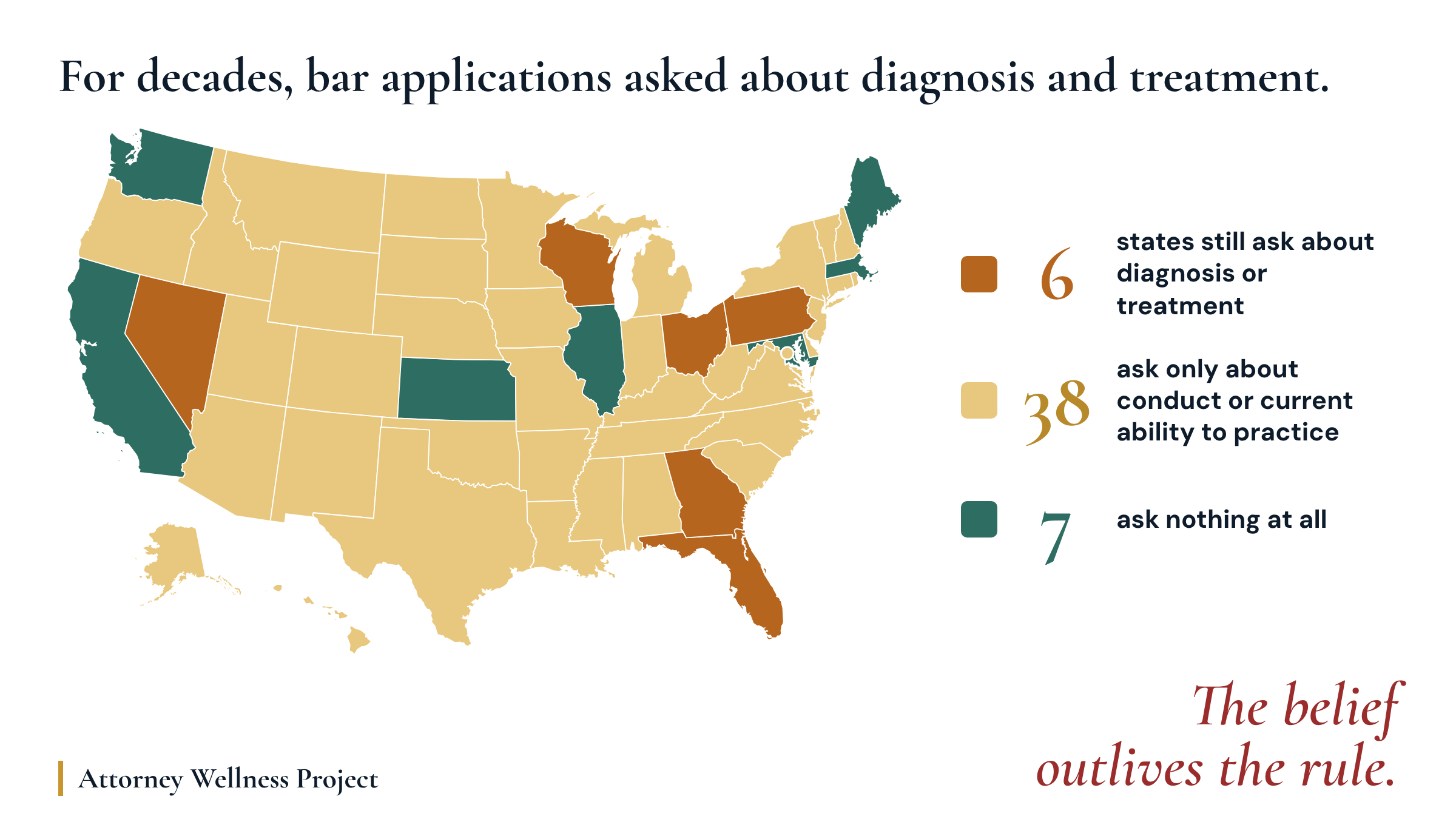
For decades, bar character and fitness applications in many jurisdictions asked broad questions about mental health diagnosis and treatment. A generation of lawyers learned, during the most anxious months of their professional lives, that a diagnosis was something the licensing body wanted to know about. That lesson persists long after admission, and it persists even where the question no longer does.

The landscape has changed substantially. Many jurisdictions have narrowed or removed those questions, shifting toward inquiries about current conduct and current capacity rather than diagnosis or treatment history. But the change has been uneven and it has been quiet. Lawyers admitted under the old regime are frequently operating on outdated information.

The belief that seeking treatment endangers a license outlives the rule that created it, and does more damage than the rule ever did.

Confirm the current position with your own jurisdiction or its lawyer assistance program. Do not rely on what was true when you sat for the bar.

Fear of consequences inside the firm

The second barrier is closer to home and harder to legislate away. In an up-or-out partnership structure, in a practice where staffing decisions are discretionary and often informal, a lawyer has a rational basis for worrying that a disclosure will change how work is allocated.

The worry is not paranoid. Industry research has found that a substantial share of matter resourcing decisions are driven by personal preference rather than merit or capacity. Where staffing is preference-driven and undocumented, a person who has revealed a vulnerability has reasonable cause to expect that it will be factored in, quietly, with no decision they can point to.

This is an organizational problem with an organizational solution, and it is one of the few barriers a firm can address directly: make resourcing decisions explicit and reviewable, and the fear loses most of its foundation.

The culture of endurance

The third barrier is the profession's own image of itself. Legal training selects for and rewards a specific set of traits: tolerance for pressure, willingness to absorb workload, reluctance to concede. Those traits are genuinely useful. They also make asking for help feel like a category error.

The adversarial habit compounds it. A lawyer spends their working life not showing weakness to an opponent, and that discipline does not switch off cleanly at the office door or in front of a supervising partner.

The research offers a direct counterweight. Lawyers working in environments that valued professionalism, skill, and humanity above productivity and constant availability were measurably healthier and reported lower stress. The variable was not individual toughness. It was what the organization treated as the point of the job.

Not knowing what asking would even look like

The fourth barrier is the most tractable and the least discussed. Many lawyers do not seek help because they have no concrete model of what it would involve, what it would cost, how long it would take, or who would know.

Every jurisdiction has a lawyer assistance program. Most are free. Most operate under confidentiality provisions, and many are structured deliberately outside the disciplinary process. Very few lawyers can describe how theirs works, which means the option is theoretically available and practically invisible.

What actually reduces the gap

Awareness campaigns move help-seeking very little on their own. What the broader literature supports is more specific:

If this is about you

Your state's lawyer assistance program is the appropriate first call, and you can find it through the ABA Commission on Lawyer Assistance Programs. Contact is confidential in most jurisdictions and separate from the disciplinary process in many; ask the program directly what its terms are.

If you would rather start privately, the professional quality of life self-assessment scores in your browser and transmits nothing. It is not a diagnostic instrument, and it is not a substitute for talking to someone.

If you are in crisis, the 988 Suicide and Crisis Lifeline is available by call or text at any hour.

Common questions

Will seeking mental health treatment affect my law license?

In most jurisdictions, seeking treatment voluntarily does not itself trigger any reporting obligation. Bar character and fitness inquiries have shifted substantially over the past decade, with many states narrowing or removing broad questions about mental health diagnosis and treatment in favor of questions about current conduct and capacity. Requirements vary by jurisdiction and change over time, so confirm the current position with your own bar or lawyer assistance program rather than relying on what was true when you were admitted.

Are lawyer assistance program conversations confidential?

Lawyer assistance programs operate under confidentiality provisions in most jurisdictions, and many are structured specifically so that contact is separate from the disciplinary process. The specific protections differ by state. Ask the program directly what its confidentiality terms are before you disclose anything; a program that cannot answer that question clearly is one worth asking twice.

Why is help-seeking lower among lawyers than other professions?

The research points to several reinforcing factors: concern about professional consequences, concern about confidentiality, a professional culture that treats endurance as competence, and the adversarial habit of never showing weakness to an opponent. The 2016 national study found fear of others finding out and concerns about privacy among the most commonly cited barriers.

Does asking for help mean I am impaired?

No. Impairment is a specific condition in which a lawyer's capacity to represent clients competently is currently compromised. Most people who seek support are nowhere near that threshold, and seeking support early is precisely what keeps them from approaching it. The conflation of help-seeking with impairment is itself one of the barriers.

Firms can lower the barrier. Most haven't tried.

Attorney Wellness Project works with firms, courts, and bar associations on the conditions that make asking possible: leadership capability, transparent resourcing, and training delivered by people who have practiced.

Schedule a Consultation For Law Firms